About › Talks › Compliance and enforcement
Talk · October 13, 2023
Supplemental Environmental Project: The Forgotten Penalty Reduction Tool
- Event
- Arkansas Environmental Federation, 56th Annual Convention, Hot Springs (air session)
- Role
- Presenter
- Topic
- Compliance and enforcement
See the full slides
About the talk
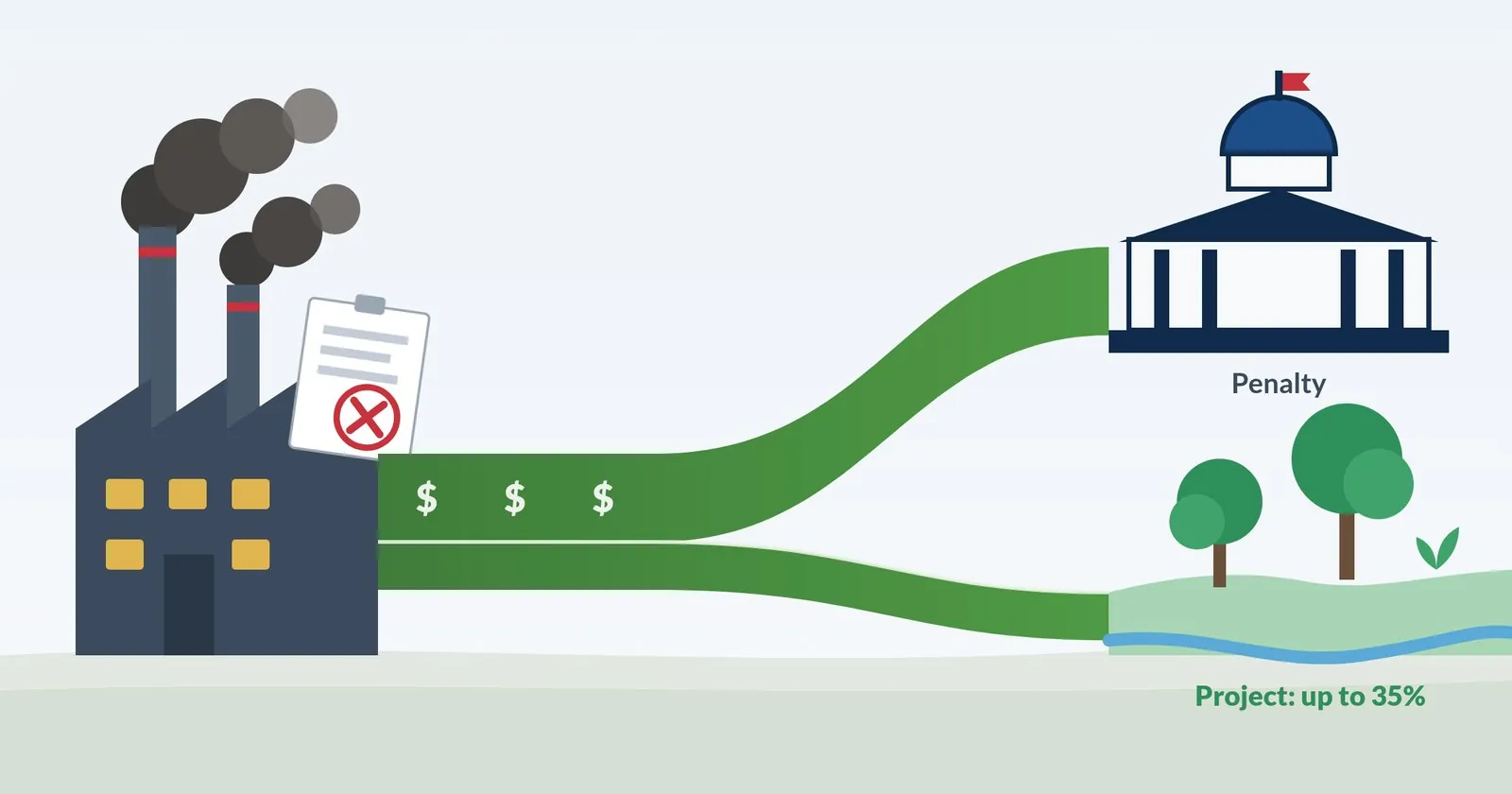
When an environmental enforcement case settles, the penalty is usually the whole story. A Supplemental Environmental Project, or SEP, offers another path: the company agrees to fund or carry out a project that benefits the environment, beyond anything the law already requires it to do, and part of the penalty is reduced in return.
Arkansas has had a SEP program for years, written to line up with EPA's federal policy, yet by 2023 it had last been used by a regulated entity 10 to 15 or more years earlier. This talk set out how SEPs work under Arkansas law and DEQ's guidelines, how they compare with the federal program, and what a SEP proposal to DEQ needs to contain.
Key points
- What counts as a SEP. DEQ defines it as an in-kind service or cash contribution to an environmental project that a party agrees to carry out as partial settlement of an enforcement action, that it is not otherwise required to do, and from which it keeps no monetary benefit, however remote.
- Where the authority comes from. Arkansas Code § 8-4-103(f)(3), in the Arkansas Water and Air Pollution Control Act, with very similar language in §§ 8-6-204(e)(3) and 8-7-204(e)(3).
- How much it can reduce a penalty. Generally up to 35 percent of the administrative penalty, at the director's discretion. At least $1 must be spent for each $1 of reduction; projects that directly reduce pollution or clean up contamination can count at 1:1, while projects with only indirect benefits count at 3:1. A SEP does not reduce the part of a penalty that recovers the economic benefit of noncompliance.
- When DEQ will consider one. The violations must be corrected, any resulting pollution remediated, deterrence still served, and there must be a sensible relationship between the violation and the project, or an overriding public and environmental benefit.
- What qualifies. Projects that prevent or reduce pollution beyond legal requirements, restore the environment near the violation, give technical help to entities DEQ does not regulate that face economic or technical hardship, support community education and engineering, or fund public works beyond what the law requires. Anything needed to come into compliance, or already required or completed, does not qualify.
- The federal picture. EPA and DOJ have used SEPs to advance each administration's goals, and the policy has swung with administrations: revised under President Obama in 2015, cut back under President Trump, and restored under President Biden. Federal SEP projects have included replacing chlorine gas with sodium hypochlorite at a facility, donating equipment to a fire department, replacing lead water mains in a Kalamazoo neighborhood, and upgrading a city wastewater plant.
- What a proposal to DEQ needs. The recipient and its written commitment, a project name, the DEQ staff contact, the area that will benefit (preferably the community where the violation happened), the project type and description, the expected environmental benefits, an itemized cost, a schedule, how the money will be accounted for and reported, and any other funding. DEQ also keeps community-proposed projects on file for future settlements.
- The fine print. DEQ reviews compliance history and can refuse a SEP because of it. The company must show it can carry out the project and report on it, any unspent SEP money becomes penalty, and the company pays for any third-party oversight.
What has changed since · checked October 31, 2026
Federal SEPs are off the table; Arkansas's are not
The federal swing continued after this talk. On February 5, 2025, the Attorney General rescinded the 2022 guidelines that had allowed SEPs in Justice Department settlements. On December 5, 2025, EPA's enforcement office followed for its own settlements:
"Until additional guidance on the use of SEPs in settlement agreements is issued, no settlement shall include a SEP."
Arkansas DEQ's SEP guidelines are unchanged: the same 35 percent general limit and the same 1:1 and 3:1 ratios, with governmental entities eligible for reductions of up to 50 percent. For an enforcement case brought by DEQ rather than EPA, the state SEP remains available, which makes this forgotten tool more relevant now than when the talk was given.
Primary sources
Every link was checked on October 31, 2026; archived copies are kept in case a page moves.
Arkansas
- Arkansas DEQ: Supplemental Environmental Project (SEP) and Proposal Guidelines (archived copy)
The state guidelines the talk was built on: definition, penalty reduction, criteria and proposal elements. - Arkansas Code Annotated §§ 8-4-103(f)(3), 8-6-204(e)(3) and 8-7-204(e)(3)
The statutory authority for SEPs in Arkansas enforcement settlements. Search the code by section number. - APC&EC Regulation 7: Civil Penalties (archived copy)
- Arkansas DEQ Uniform Penalty Policy (archived copy)
- Arkansas DEQ Environmental Self-Disclosure Incentive Policy (archived copy)
Federal
- EPA: Supplemental Environmental Projects (SEPs) (archived copy)
- EPA: 2015 Update to the 1998 Supplemental Environmental Projects Policy (March 10, 2015) (archived copy)
The federal policy in force at the time of the talk. - U.S. Attorney General: Guidelines and Limitations for Settlement Agreements Involving Payments to Non-Governmental Third Parties (May 5, 2022) (archived copy)
The memo that brought SEPs back in 2022. - U.S. Department of Justice final rule, Federal Register (December 9, 2024) (archived copy)
Finalized the 2022 interim rule that had revoked the 2020 ban on third-party payments. - U.S. Attorney General: Reinstating the Prohibition on Improper Third-Party Settlements (February 5, 2025) (archived copy)
- EPA OECA: Reinforcing a "Compliance First" Orientation for Compliance Assurance and Civil Enforcement Activities (December 5, 2025) (archived copy)
Section 5: "Until additional guidance on the use of SEPs in settlement agreements is issued, no settlement shall include a SEP." - EPA Enforcement and Compliance History Online (ECHO)
The data behind the talk's chart of federal settlements that included a SEP, 2015 to 2023.
Coverage
This page describes a talk given on October 13, 2023, with the update above checked on October 31, 2026. It is a summary for general information, not legal or engineering advice, and the views are my own, not those of any employer.